

Member's Hub Home
First
email@email.com

35 retailers and brands from the outdoor industry have been researching and testing ways to reduce the impact of their single use plastic packaging. Here is some of what we’ve learned and what we are doing.
"Biodegradable’ plastic doesn't do what you think it does. Your paper or metal straw takes only a tiny sip at the problem of plastic pollution. And your supposedly eco-conscious cloth grocery bag is more damaging to the environment than conventional plastic bags—unless you reuse it literally thousands of times. In other words, many of our ideas about plastic and the environment are confused. And that may be getting in the way of the fight against global warming.” Wade Roush, Scientific American
“In many cases plastics are actually better for the environment than the alternatives. It is surprising until you look closely at it.” Susan Selke, Director of the school of packaging, Michigan State University.
“It is not as simple as ‘plastic is bad’ so let’s use something else. It will require a complete change in the way we use product packaging at the moment. Most packaging is now used just once and thrown away. We need to move away from that.” Eliot Whittington, policy programme director, University of Cambridge’s Institute for Sustainability Leadership
Environmental Project no. 1985. The Danish Environmental Protection Agency February 2018
Theoretical Substitution Analysis. April 2018
PREPARED FOR: The Plastics Division of the American Chemistry Council (ACC)
BY: Franklin Associates, A Division of Eastern Research Group (ERG).
A Review of the Bags Available in 2006. Environment Agency, UK 2011
Hsien Hui Khoo, Reginald B. H. Tan, Kevin W. L. Chng. 2010
Recyclable Plastic; Compostable, Biodegradable Plastic; and Recycled, Recyclable Paper. Chaffee, Chet & R. Yaros, Bernard.2007
Analyse du cycle de vie de sacs de caisse en plastique, papier et matériau biodégradable.
Rapport préparé pour CARREFOUR. Revue critique organisée par l’ADEME. July 2004
For materials recycling facilities, plastic film can, “seriously harm the efficient operation of plant and machinery.” They may view the film as, “unwanted plastic film contaminant” and therefore “employ a series of counter-measures to mitigate contamination.”— Lee Bradbury, operations manager at Casepak’s Leicester MRF
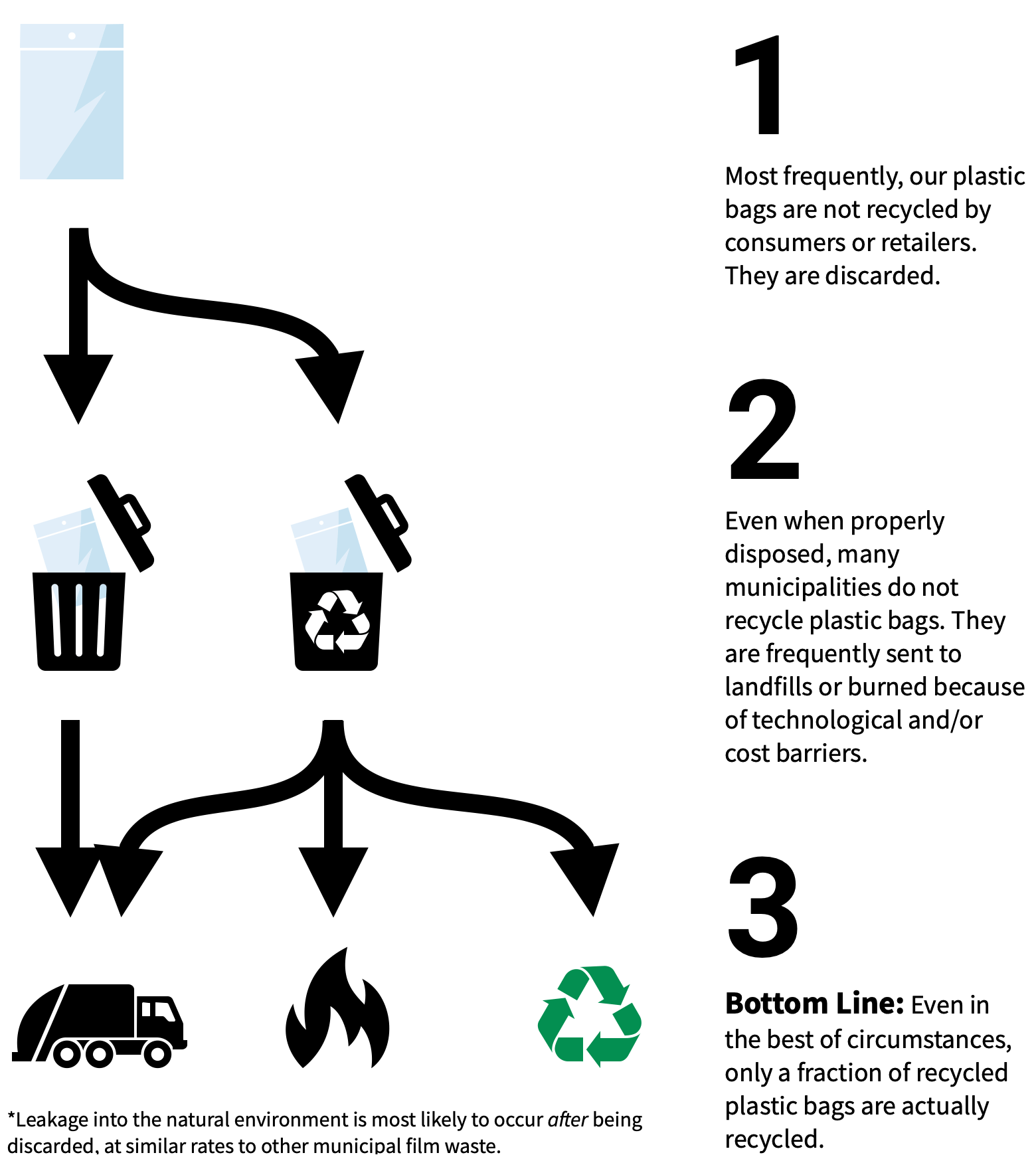
It relies on consumers to be responsible, and municipalities to be capable of caring for our plastic bags. Currently, products are placed in protective plastic bags at the manufacturer and stay that way until they are taken out by the consumer after a purchase. The plastic bag is then discarded.
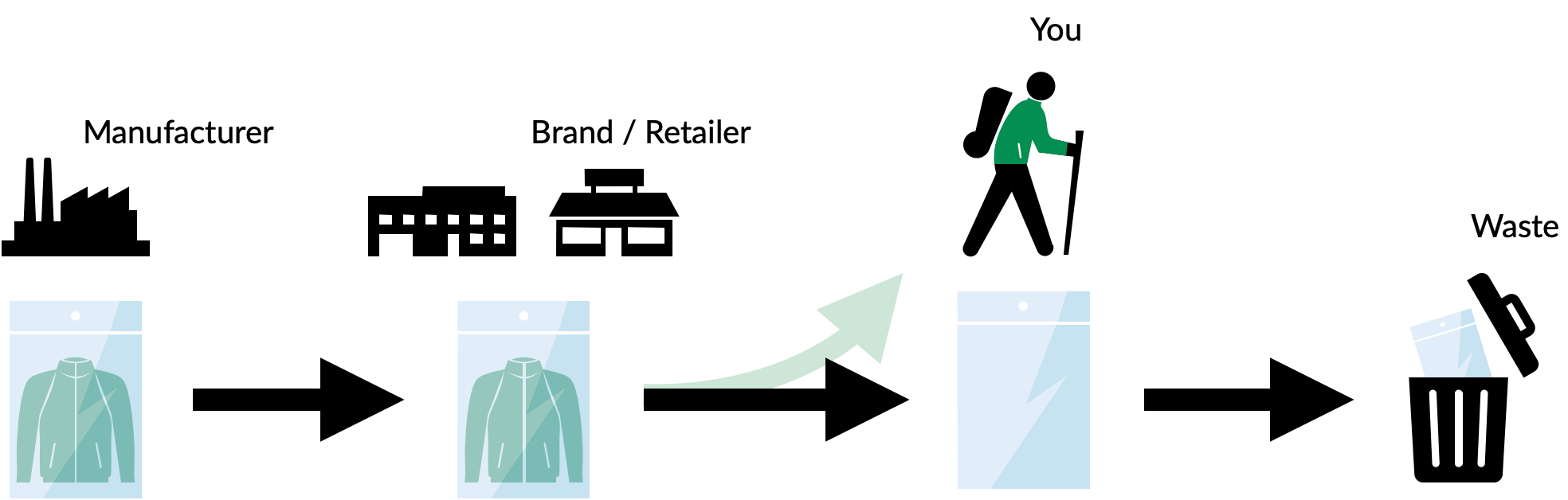
Consumers should be responsible, and municipalities should be capable, but we can help too.
Our aim is to sell the consumer the product (in store or online), but first remove the plastic bag, combine it with other bags, and then send them to a designated recycler. To do this we have joined together in a pan-European collaboration with specific recyclers who we can trust will keep our plastic bags out of landfills or incinerators. The recycler opens a dedicated line for our material because of the volumes we can provide by working together.
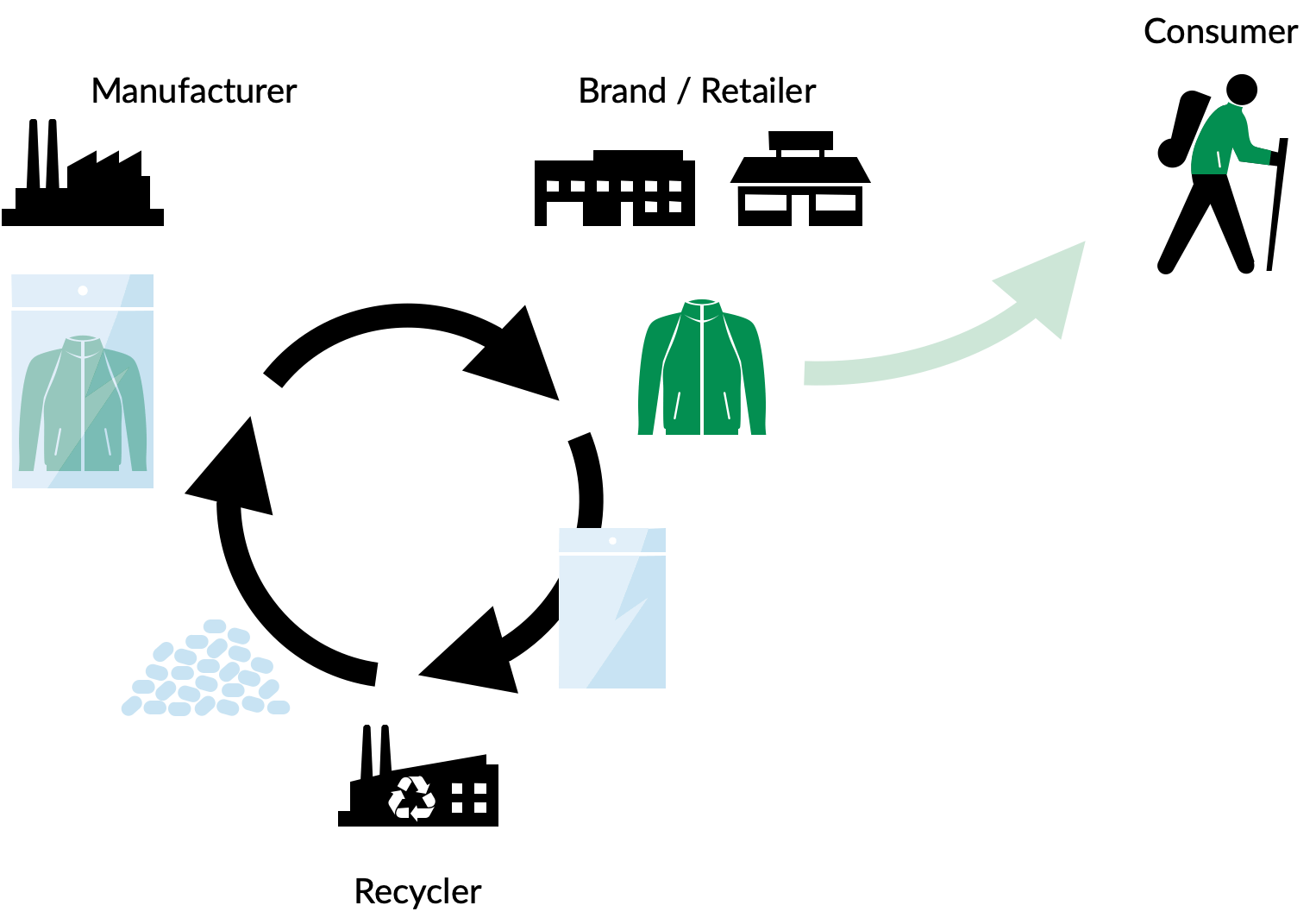
We can create an industry-sized stream of clean, pre-sorted, homogenous plastics. These could be used for new products or even potentially in future generations of plastic bags. During 2019, we were able to successfully test this system using several brands and retailers from the project group.

As noted above, we feel it is very important to take into account the fact that LCAs agree that no other alternative material is superior to plastic when considering the entirety of its lifecycle.
We’ve targeted the largest piece of the pie.

Collecting bags from retail stores or from select outgoing shipments may seem small, but it represents a massive segment of the problem. When implemented correctly, this process stands to displace as much as of 86% of the industry’s total poly bags.
This movement is good for business and supported by customers.

During our tests we surveyed end users about their experience, and feedback for the project. The Net Promoter Score (NPS), or customer satisfaction, for end users who participated in the first project tests was an impressive 76 which is industry-leading.
Customers indicated their support and an increased likelihood to recommend participating companies.
This type of scenario fits within our expertise.

Not all of us are subject matter experts on plastics and material alternatives, and even the experts seem to disagree on the best solutions. But we do understand our own supply chain, and are capable of organising the resources already available to accomplish far more.
Our solution uses existing systems and capex, and does so better than current methods.

We would prefer to use machinery already in place for production, and bolster municipal waste infrastructure for its reprocessing. Our first tests collating plastic bags into a recycling stream received the second highest grade of PCR typically sold on the market.

This system helps recyclers and connects producers to waste managers. It’s much easier to say that the waste management system is broken than to sit down with recyclers and work together. We can offer to send them a clean, pre-sorted, homogenous stream of exceptionally high-grade plastics. One that has a higher-than-average yield, and takes significantly less energy to reprocess. We feel encouraged to leverage the current waste management systems and provide a model for conserving other material types.
An industry recycling stream works broadly.

According to our research, this system fits within the context of almost every retailer and brand which currently uses poly bags to protect their. products. In 2020 we intend to continue refining and improving scalability.
The Single Use Plastics Project is an initiative of the European Outdoor Group
